 a journal of interesting technical ideas . . . a journal of interesting technical ideas . . .
This is a long post, but most of it is file contents. Keep reading!
GNS3 appliance files are descriptions of virtual machines used in network simulations. The appliance files have suffixes of .gns3a and are included with the GNS3 download. You can update the files and create new ones. The goal of this article is to walk through the process of working with appliance files and contributing them back to the community.
On a personal note, submitting a new GNS3 appliance was the first time I contributed to an open-source project. I’m still learning, but a few years ago I knew nothing. Jeremy Grossman, with GNS3, was patient and helped me understand the process of using Git. Contributing - even in this minor way - was a real high for me and I’d love for you to be able to share that feeling and contribute to this and other projects. GNS3a was my “gateway drug” into being a contributor and not just a consumer of open source.
One of the files I’ve contributed is the Security Onion appliance. Security Onion is a Linux distribution that focuses on security tools. Below is the current version (9/1/20) of the GNS3A file. Before we create a new appliance, let’s update this one.
Crying helps the body flush out excess stress hormones like cortisol.
: Focus on "keep praying" and interacting with Student A.
When users explore complex adult themes or deeply human dramas on platforms like Doujindesu.tv, they often encounter raw, unfiltered depictions of isolation, trauma, and redemption. These narratives can act as a mirror to the reader's real-life struggles, leading to a profound "cry" that sparks personal change. 3. How Narrative Media Triggers Life Transformation
In that moment, something shifted inside me. Crying was no longer a sign of weakness but a sign of strength. I realized that I had been living in a state of emotional numbness, disconnected from my feelings and my body. Crying allowed me to tap into my emotions, to process and release the pain, and to reconnect with myself. It was liberating.
Re-evaluating personal relationships, career choices, or daily habits. Closing the screen with a renewed perspective. Actively making lifestyle changes to "turn life around." 5. Summary
Unfollow accounts or leave communities that trigger negative self-comparison. Step 4: Seek Structured Support Lean on trusted friends within your communities.
The phrase turning my life around has become a cliché, reserved for recovery memoirs and motivational TED talks. But real turning points are rarely grand. They are small, humiliating, and wet with tears. In my case, it was a black-and-white doujin manga, no more than thirty pages, about a character who had given up. Not dramatically — no suicide note, no final scream — just a quiet, daily giving-up: skipping meals, avoiding mirrors, letting friendships rot like fruit left in the sun. The protagonist’s face was drawn crudely, almost amateurishly, and yet in one panel, they sat alone in a rented room, watching a small TV that only played static. That static was my own life reflected back.
The cry, then, was not of sadness but of relief. For years, I had been searching for a grand reason to change — a sign from the universe, a mentor’s speech, a near-death experience. Instead, I got a poorly drawn character and a grammatical particle. And that was enough. Because doujin, at its best, does not offer solutions. It offers company . It says: I have felt this too. Here is a drawing of it. You are not broken; you are witnessed.
This likely refers to a personal story or a popular internet post about someone named (possibly a YouTuber, streamer, or content creator) whose TV show (or streaming activity) turned their life around, with a strong emotional “cry” as a turning point.
Before this turning point, my world was a muted grey. I was a university student who had perfected the art of invisible suffering. On paper, everything was fine: good grades, a stable family, a roof over my head. Internally, however, I was a hollow shell. Years of social anxiety and undiagnosed depression had convinced me that connection was a trap. I went to classes, came home, scrolled endlessly through social media, and slept. I was not living; I was waiting for time to pass. Music, which had once been a passion, had become just noise. I had dismissed “doujin” music as amateurish, the awkward cousin of commercial J-pop. To me, it was for obsessive fans, not for someone like me who had given up on feeling anything at all.
Research and cultural analysis suggest that the connection between fans and VTubers (or doujinshi creators) operates on a principle of emotional synchrony . As one analysis notes, when fans watch a VTuber, they “connect not through rational thought but through emotional synchrony,” causing loneliness and overthinking to fade away. Psychologically, this is a form of “recovery behavior”—a way for the brain to heal from the fatigue of being overly rational and isolated.
To understand the broader context of this keyword, it must be broken down into three distinct thematic sections:
Most of this is pretty straight forward. The structure looks like:
A descriptive section
Next is the Qemu section that describes how the VM environment should be constructed. This is straightforward as well. Console types are VNC or telnet. You may have to try different ethernet adapters to see what works, but I recommend starting with the Intel e1000 because this model is supported by most VMs. Using a para-virtualized adapter may give better performance, so you may also want to try vmxnet3. Most architectures will be 64bit and RAM requirements will usually be on the website.
That leaves two sections - Images and Versions. There should be a matching entry in both places. The images section is a list of virtual hard drives and CD-ROM images to use in the VM and includes:
Let’s update this file. There are a lot of old images listed as options. I’ll remove the image and version sections for 14.04.5.3 and add the most recent (16.04.7.1). That will leave users with the last 14.x and two images in 16.x including the latest. Whether dealing with a distribution or a commercial image, changes made between versions may introduce new processes or bugs so leaving some older images gives users an easy workaround. Here’s the updated file. Scroll below the output for a discussion of submitting this back to the project.
Crying helps the body flush out excess stress hormones like cortisol.
: Focus on "keep praying" and interacting with Student A.
When users explore complex adult themes or deeply human dramas on platforms like Doujindesu.tv, they often encounter raw, unfiltered depictions of isolation, trauma, and redemption. These narratives can act as a mirror to the reader's real-life struggles, leading to a profound "cry" that sparks personal change. 3. How Narrative Media Triggers Life Transformation
In that moment, something shifted inside me. Crying was no longer a sign of weakness but a sign of strength. I realized that I had been living in a state of emotional numbness, disconnected from my feelings and my body. Crying allowed me to tap into my emotions, to process and release the pain, and to reconnect with myself. It was liberating. doujindesutvturningmylifearoundwithcry
Re-evaluating personal relationships, career choices, or daily habits. Closing the screen with a renewed perspective. Actively making lifestyle changes to "turn life around." 5. Summary
Unfollow accounts or leave communities that trigger negative self-comparison. Step 4: Seek Structured Support Lean on trusted friends within your communities.
The phrase turning my life around has become a cliché, reserved for recovery memoirs and motivational TED talks. But real turning points are rarely grand. They are small, humiliating, and wet with tears. In my case, it was a black-and-white doujin manga, no more than thirty pages, about a character who had given up. Not dramatically — no suicide note, no final scream — just a quiet, daily giving-up: skipping meals, avoiding mirrors, letting friendships rot like fruit left in the sun. The protagonist’s face was drawn crudely, almost amateurishly, and yet in one panel, they sat alone in a rented room, watching a small TV that only played static. That static was my own life reflected back. Crying helps the body flush out excess stress
The cry, then, was not of sadness but of relief. For years, I had been searching for a grand reason to change — a sign from the universe, a mentor’s speech, a near-death experience. Instead, I got a poorly drawn character and a grammatical particle. And that was enough. Because doujin, at its best, does not offer solutions. It offers company . It says: I have felt this too. Here is a drawing of it. You are not broken; you are witnessed.
This likely refers to a personal story or a popular internet post about someone named (possibly a YouTuber, streamer, or content creator) whose TV show (or streaming activity) turned their life around, with a strong emotional “cry” as a turning point.
Before this turning point, my world was a muted grey. I was a university student who had perfected the art of invisible suffering. On paper, everything was fine: good grades, a stable family, a roof over my head. Internally, however, I was a hollow shell. Years of social anxiety and undiagnosed depression had convinced me that connection was a trap. I went to classes, came home, scrolled endlessly through social media, and slept. I was not living; I was waiting for time to pass. Music, which had once been a passion, had become just noise. I had dismissed “doujin” music as amateurish, the awkward cousin of commercial J-pop. To me, it was for obsessive fans, not for someone like me who had given up on feeling anything at all. These narratives can act as a mirror to
Research and cultural analysis suggest that the connection between fans and VTubers (or doujinshi creators) operates on a principle of emotional synchrony . As one analysis notes, when fans watch a VTuber, they “connect not through rational thought but through emotional synchrony,” causing loneliness and overthinking to fade away. Psychologically, this is a form of “recovery behavior”—a way for the brain to heal from the fatigue of being overly rational and isolated.
To understand the broader context of this keyword, it must be broken down into three distinct thematic sections:
In GNS3, go to File > Import Appliance and make sure that your appliance imports correctly. GNS3 will provide guidance if there’s a formatting error. Looking at the JSON above, you can imagine that a common mistake is unmatched brackets!
If the GNS3a file loads, test it by creating an instance. You need to test at least any new versions you added. Make sure the appliance boots without error and that expected interfaces are available.
Once the pieces are working, submit the appliance to the community by cloning the GNS3-registry on Github and adding in your file.
git clone https://github.com/GNS3/gns3-registry.git
If you’ve already cloned it, make sure that your branch is up to date. Upstream is the original source (in this case the GNS3 copy).
git fetch upstream
Two Python programs are included in the repo. Run them both on your copy before continuing. These are QA processes that look for issues before you submit. They will take a little time to run.
pip3 install -r requirements.txt   # this does __pip3 install jsonschma__ and __pip3 install pycurl__
python3 check.py
python3 check_url.py
Next push your local copy to your github copy. In Github terms, origin is your copy on Github, and master is the local copy.
git add .
git commit -m "Updated Security Onion"
git push -f origin master
Now we have an up to date local copy of the gns3-registry that includes our updated gns3a appliance and we’ve updated our fork on Github. Next, we offer our update to the project via a Pull Request. You are going to be one of the cool kids!
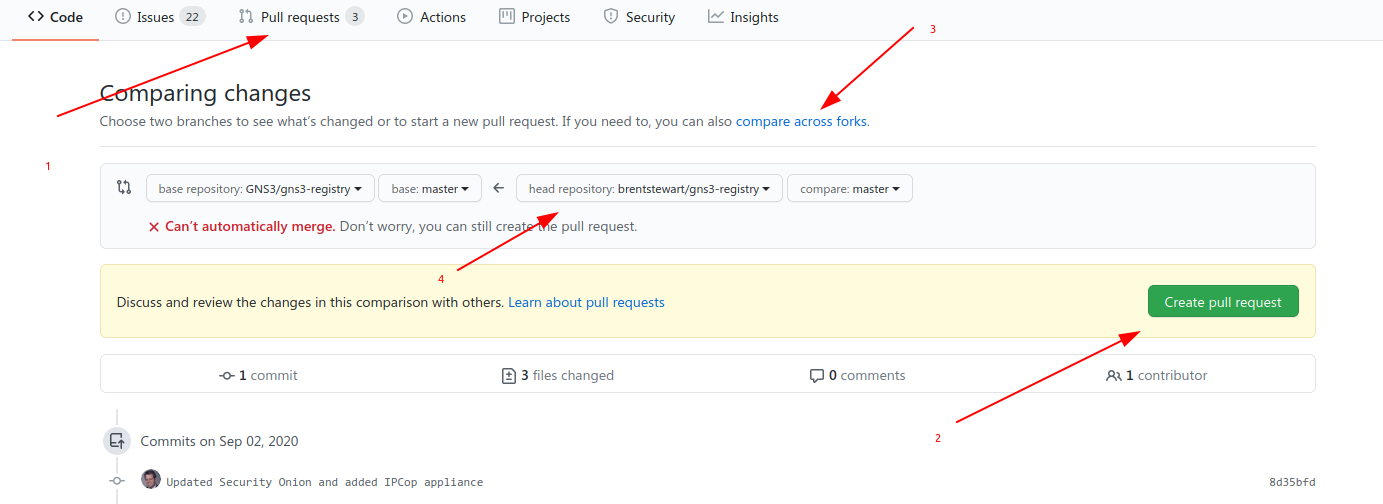 Go to the gns3-registry repository on Github and select the Pull Requests tab and click the big green New pull request button. Under Compare, select the link to compare across forks (since your copy is a fork) and select your fork. It should show you the changes to files so take a moment to digest that and make sure this PR is doing what you want. Finally, submit the Pull Request. Github will email you when there’s an update to the request. If the GNS3 team has a question, they’ll submit a comment on the PR and leave it open for you to resolve. Otherwise, it will get merged in and all the other GNS3 users will be able to enjoy your hard work!
Thanks!